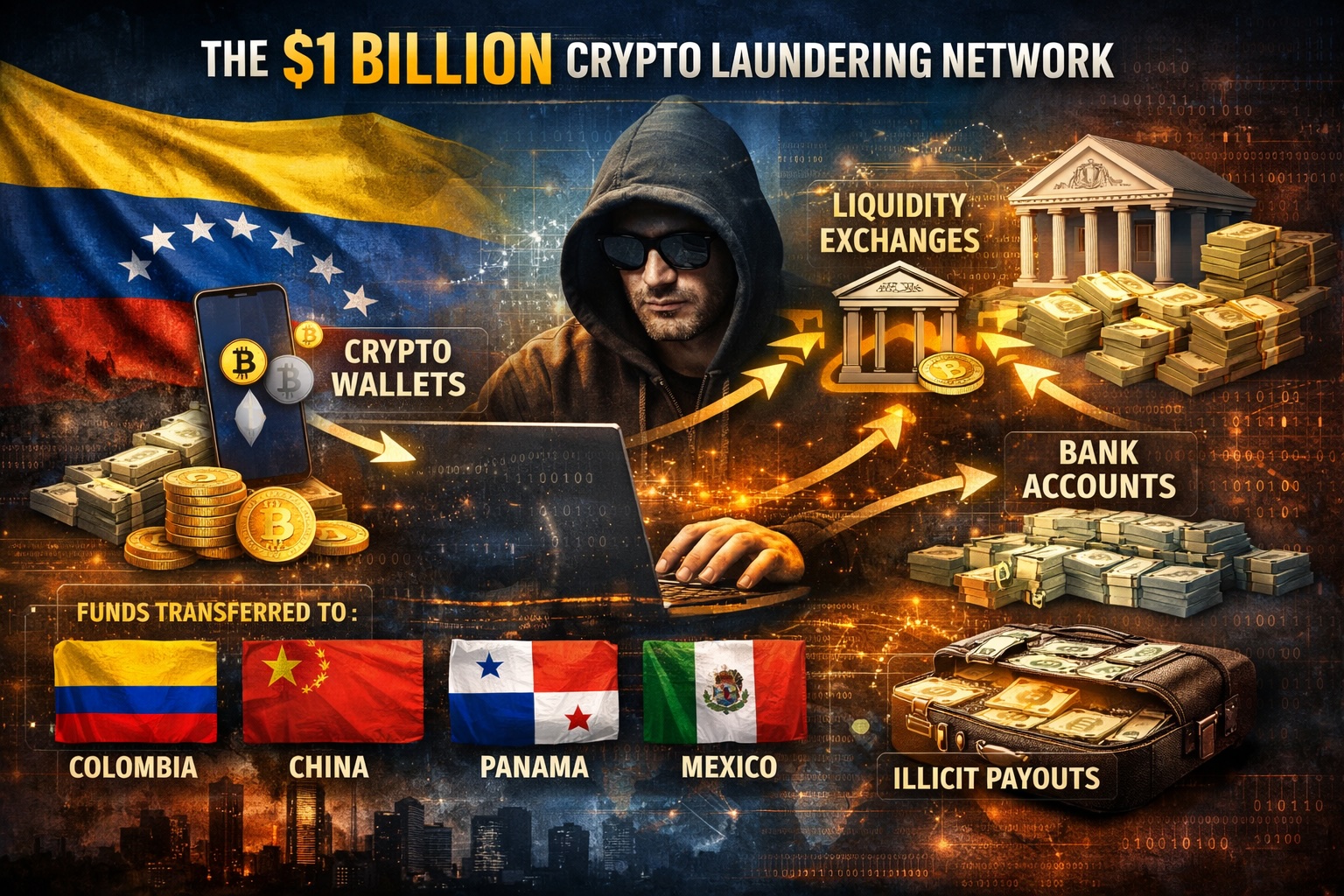
Inside a Modern, Cross-Border Financial Crime Operation
In January 2026, the U.S. Attorney’s Office for the Eastern District of Virginia announced criminal charges against Venezuelan national Jorge Figueira for allegedly laundering approximately $1 billion in illicit funds through cryptocurrency and traditional financial systems.
From a BlockDivers perspective, this case is not remarkable because cryptocurrency was involved. It is remarkable because it illustrates—clearly and at scale—how modern money laundering networks actually operate when crypto is used as a tool rather than the crime itself.
This is what a billion-dollar laundering pipeline looks like in practice.
Step One: Crypto as a Conversion Layer, Not the Origin
According to the complaint, the majority of inbound funds into Figueira’s accounts originated from cryptocurrency trading platforms. This distinction matters.
In many public narratives, cryptocurrency is portrayed as the “source” of criminal proceeds. In reality, large laundering operations typically use crypto as an intermediate conversion layer—a way to move value quickly, globally, and with fewer immediate gatekeepers.
At this stage, laundering networks commonly rely on:
- Accounts opened in the names of subordinates or nominees
- Multiple exchanges and OTC desks rather than a single platform
- Fragmented transaction sizing to avoid automated thresholds
This mirrors what BlockDivers routinely sees in pig-butchering scams, trade-based laundering, and cross-border fraud investigations.
Step Two: Private Wallets and Controlled Dispersion
Once funds are converted into cryptocurrency, they are routed through private wallets controlled by the laundering organization.
Contrary to popular belief, this stage is not about anonymity—it is about control and dispersion.
By spreading funds across:
- Multiple wallets
- Multiple blockchains
- Multiple transaction paths
the network attempts to create investigative friction, not invisibility. However, as this case demonstrates, volume itself becomes a liability. Large-scale movement creates patterns that advanced blockchain analytics can identify and cluster.
The Federal Bureau of Investigation stated it identified approximately $1 billion in cryptocurrency moving through wallets tied to this operation—an important signal that high-value laundering is increasingly traceable.

Step Three: Liquidity Providers — The Critical Chokepoint
One of the most important details in this case is the role of liquidity providers.
After crypto was moved through wallets, funds were allegedly sent to liquidity providers to be:
- Exchanged back into U.S. dollars
- Injected into the traditional banking system
This layer is frequently misunderstood and under-scrutinized. Liquidity providers often sit between:
- Exchanges and banks
- Crypto markets and wire systems
- Offshore entities and onshore accounts
From an investigative standpoint, this is where crypto laundering stops being “crypto” and becomes classic financial crime.
Step Four: Banking Integration and Distribution
Once converted to fiat, funds were transferred into bank accounts controlled by the network and then distributed onward to businesses and individuals across multiple jurisdictions.
The complaint specifically identifies outbound flows to:
- Colombia
- China
- Panamá
- Mexico
Each of these jurisdictions plays a recurring role in global laundering typologies:
Panamá
Panamá remains a strategic financial transit jurisdiction due to:
- Its role as a regional banking hub
- Corporate secrecy structures
- Historical exposure to shell companies and nominee directors
In BlockDivers investigations, Panamá frequently appears as a pass-through jurisdiction, not the final destination—used to layer funds before onward movement.
Colombia and Mexico
Both countries are commonly associated with:
- Trade-based money laundering
- Cash-intensive businesses
- Complex cross-border payment flows
Crypto increasingly serves as a bridge between informal value systems and formal banking in these regions.
China
China’s inclusion is particularly notable, as it often indicates:
- Trade settlement mechanisms
- Underground banking networks
- Use of intermediaries rather than direct account ownership
When China appears alongside crypto laundering, it often signals commercial or trade-linked laundering, not retail fraud.
What This Case Actually Tells Us
From a forensic standpoint, this case reinforces several realities:
- Crypto laundering at scale is no longer invisible
Large volumes create identifiable transaction behavior. - The weakest points are not wallets—they are intermediaries
Liquidity providers, exchanges, and banks remain the true enforcement chokepoints. - Jurisdictional patterns matter more than individual transactions
Clustering by geography often reveals intent long before a single transfer looks suspicious. - Crypto laundering increasingly mirrors traditional laundering
The tools are new; the structures are not.
Why This Matters
If proven, this case will not stop with one defendant.
Investigations of this magnitude typically expand outward to examine:
- Exchanges that processed the funds
- Liquidity providers that facilitated conversion
- Banks that received or transmitted proceeds
- Businesses that benefited from the flow of illicit capital
For investigators, compliance teams, and victims alike, the lesson is clear:
crypto does not eliminate traceability—it compresses timelines.
At BlockDivers, this is exactly where blockchain forensics, OSINT, and traditional financial analysis converge.