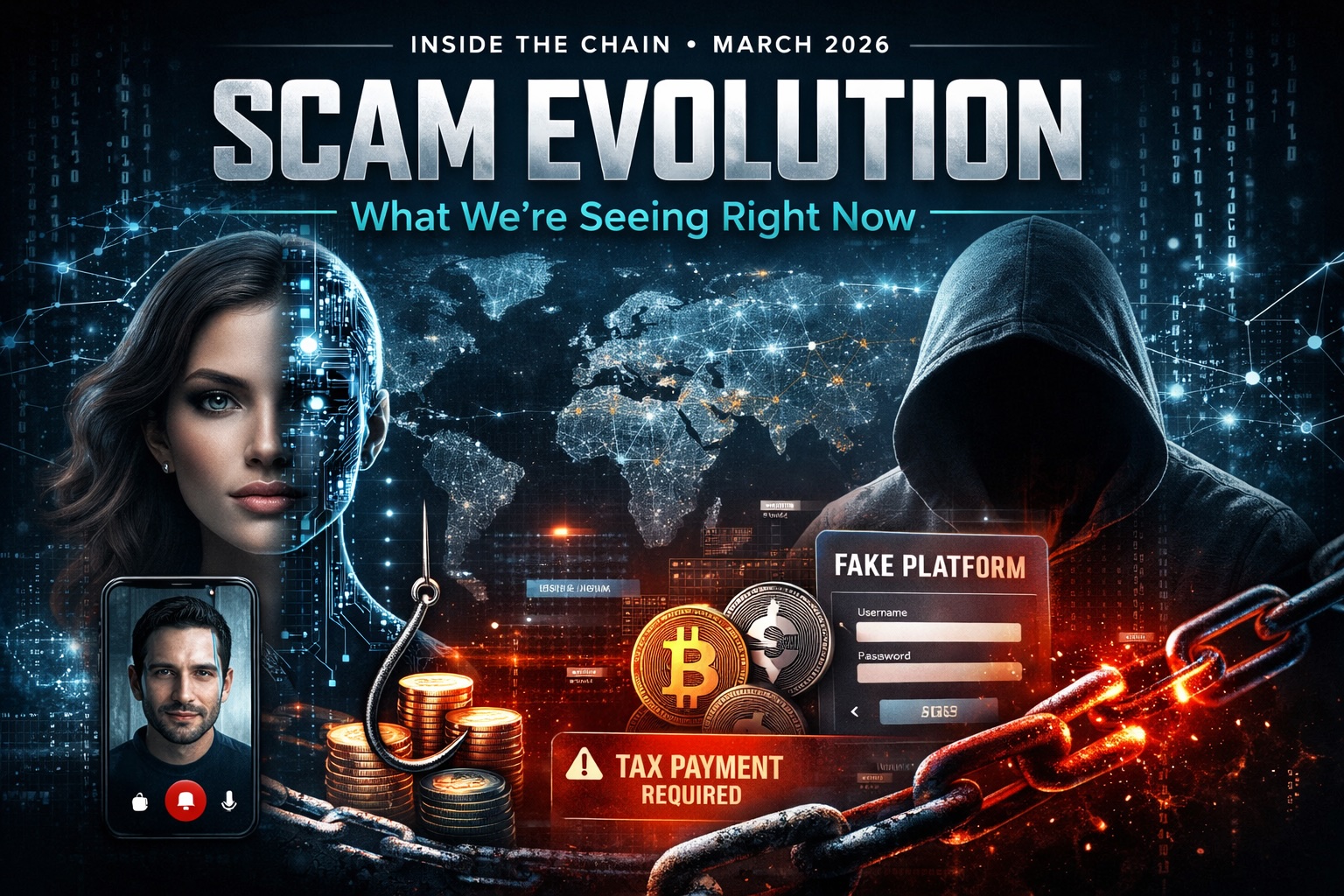
Crypto scams are not slowing down—they’re evolving.
What worked in 2023 no longer works today. The actors behind these operations are becoming more sophisticated, more patient, and more convincing. In several recent cases, victims didn’t fall for obvious fraud—they were methodically engineered into it.
The biggest risk right now isn’t ignorance.
It’s false confidence.
🔍 The Shift: From Fraud to Engineering
We are no longer dealing with simple scams.
We are seeing structured, multi-phase operations designed to:
- Build trust over weeks or months
- Simulate legitimacy across multiple channels
- Control the victim’s decision-making environment
These are not opportunistic actors.
These are systems.
⚠️ Tactics We’re Seeing Right Now (March 2026)
1. AI-Driven Personas (Next-Level Pig Butchering)
Scammers are now deploying:
- AI-generated profile photos
- Voice cloning for calls and voicemails
- Video deepfakes for “live” interaction
What used to be text-based deception is now multi-sensory trust building.
Implication:
Traditional “red flags” (poor grammar, inconsistent tone) are disappearing.
2. Fake Platforms Using ENS + IPFS Infrastructure
We are seeing fraudulent platforms hosted via:
- ENS domains (e.g., .eth.link)
- IPFS-backed frontends
These setups:
- Avoid traditional domain takedowns
- Appear decentralized and “legitimate”
- Persist even after exposure
Implication:
Victims believe they are interacting with cutting-edge crypto infrastructure—not a scam.
3. Withdrawal Traps (The Final Extraction Layer)
Once funds are deposited, victims encounter:
- “Tax clearance fees”
- “Liquidity unlock requirements”
- “Security verification deposits”
Each step is designed to:
- Justify additional payments
- Extend engagement
- Delay realization of loss
Key Insight:
The scam doesn’t end at the first transfer—it escalates.
4. Multi-Channel Control
Scammers are no longer operating on a single platform.
We are seeing coordinated use of:
- WhatsApp / Telegram
- Email (with spoofed domains)
- Web platforms
- Phone calls with real-time interaction
Result:
Victims are surrounded by consistent, reinforcing signals that the opportunity is real.
🧠 Why Smart People Are Still Falling For This
This is not about intelligence.
These operations are designed to:
- Build emotional trust
- Introduce controlled urgency
- Normalize incremental risk
By the time funds move, the victim is not guessing.
They are convinced.
📂 Case Pattern Snapshot (Observed Across Multiple Engagements)
- Initial contact through social or professional network
- 2–6 weeks of relationship building
- Introduction to “investment platform”
- Small successful withdrawal (confidence trigger)
- Larger deposits
- Withdrawal restrictions introduced
- Escalating payment demands
- Communication breakdown
By the time the victim reaches out, funds have already been layered and moved.
❌ Myth vs Reality
Myth: “If the wallet is identified, the money can be recovered.”
Reality: Tracing is only the first step. Without enforcement strategy, it leads nowhere.
Myth: “The platform looked legitimate, so it must be regulated.”
Reality: Most of these platforms are entirely fabricated.
Myth: “Exchanges will step in if fraud is proven.”
Reality: Without legal pressure and timing, most will not act.
🎯 What This Means Going Forward
The barrier to entry for sophisticated fraud has dropped dramatically.
AI + decentralized infrastructure + global coordination =
scalable deception at a level we haven’t seen before.
This is no longer a cybersecurity issue.
It is a strategic threat environment.
🔚 Closing Insight
The industry has spent years focusing on tracing.
But tracing does not stop fraud.
And it does not recover assets.
Understanding how these scams operate—before funds move—is now the only real advantage.
🔗 Final Note
If you are evaluating a situation where funds have already been sent, timing matters. The earlier a structured response is initiated, the more options exist.