
How AI, Organized Crime, and State-Linked Networks Reshaped Financial Crime
Cryptocurrency-enabled fraud is no longer a peripheral risk to the global financial system. It has matured into a highly organized, technologically sophisticated, and globally distributed criminal economy. By the end of last year, on-chain data, law enforcement disclosures, and private-sector intelligence all converged on the same conclusion: crypto fraud has crossed the threshold from opportunistic cybercrime into full-scale industrialized activity.
Independent blockchain intelligence estimates place global scam proceeds well into the tens of billions of dollars annually, with figures continuing to rise as additional wallets, laundering routes, and affiliated infrastructure are identified retroactively. What is most striking is not simply the volume of losses, but the efficiency with which these operations now function. Fraud schemes are extracting more money per victim, operating for longer durations, and scaling faster than at any previous point in the digital asset era.
This evolution reflects a deeper structural change. Modern crypto fraud is no longer defined by isolated actors or single scam typologies. Instead, it is powered by modular criminal ecosystems that mirror legitimate technology supply chains, complete with developers, data brokers, customer acquisition specialists, payment processors, and money laundering professionals.
Impersonation as the Primary Attack Surface
One of the most consequential shifts observed over the past year has been the rise of impersonation-based fraud as a dominant vector. Criminal groups increasingly exploit institutional trust by posing as government agencies, financial institutions, logistics providers, and cryptocurrency exchanges. These schemes succeed not because of technical exploits alone, but because they weaponize credibility and urgency.
Large-scale SMS and messaging campaigns impersonating toll authorities, postal services, banks, and crypto platforms have demonstrated how inexpensive infrastructure can generate extraordinary returns when deployed at scale. In several documented cases, phishing kits costing less than a few hundred dollars enabled campaigns that reached hundreds of thousands of victims in a single day.
The sophistication of these campaigns lies in their realism. Fraudulent websites are often visually indistinguishable from legitimate government or corporate portals. Messaging content is localized, timely, and psychologically calibrated to trigger fear, compliance, or panic. In many instances, these campaigns are supported by insider data obtained through bribery, credential theft, or prior breaches, further enhancing their effectiveness.
AI as a Force Multiplier, Not a Novelty
Artificial intelligence is no longer an emerging tool in the fraud landscape; it is now embedded at the core of the most profitable operations. Deepfake voice technology, AI-generated video, large language models, and automated conversation agents are being deployed to scale social engineering beyond human limitations.
Operations linked to AI tooling consistently demonstrate higher transaction velocity, greater revenue concentration, and longer operational lifespans. AI allows a single operator to convincingly engage dozens of victims simultaneously, maintain long-running narratives in romance and investment scams, and rapidly adapt messaging based on victim responses.
Crucially, AI has reduced the skill barrier. Sophisticated deception no longer requires linguistic fluency, cultural familiarity, or technical expertise. Those capabilities are increasingly packaged and sold through underground marketplaces, turning persuasion itself into a commodity.
Crime-as-a-Service and the Modular Fraud Economy
Perhaps the most important development in the crypto crime ecosystem is the normalization of “crime-as-a-service.” Fraud operations are now assembled from discrete, purchasable components rather than built end-to-end by a single group.
Separate actors specialize in phishing kit development, victim data aggregation, spam delivery, social media account provisioning, money laundering, and asset conversion. These services are advertised, reviewed, and transacted openly within encrypted messaging platforms, primarily using stablecoins as the unit of account.
This modularity creates resilience. When one component is disrupted by law enforcement or platform enforcement, it can be rapidly replaced without dismantling the broader operation. It also enables rapid experimentation, with criminal groups testing new narratives, new targets, and new laundering pathways in parallel.
DeFi, Stablecoins, and Adaptive Laundering
Laundering patterns have evolved alongside enforcement pressure. While earlier fraud schemes relied heavily on centralized exchanges, newer impersonation-driven operations increasingly route funds through decentralized finance protocols, cross-chain bridges, and token swaps.
These pathways allow for rapid layering, jurisdictional arbitrage, and obfuscation without relying on centralized intermediaries. At the same time, criminal groups remain pragmatic: when centralized exchanges provide liquidity or exit opportunities, they are still used, often via mules or compromised accounts.
Stablecoins have emerged as the connective tissue of this ecosystem. They facilitate pricing, settlement, profit repatriation, and cross-border movement with minimal volatility risk, making them the preferred medium for both fraud operations and associated laundering networks.
The Dominant Criminal and State-Linked Actors
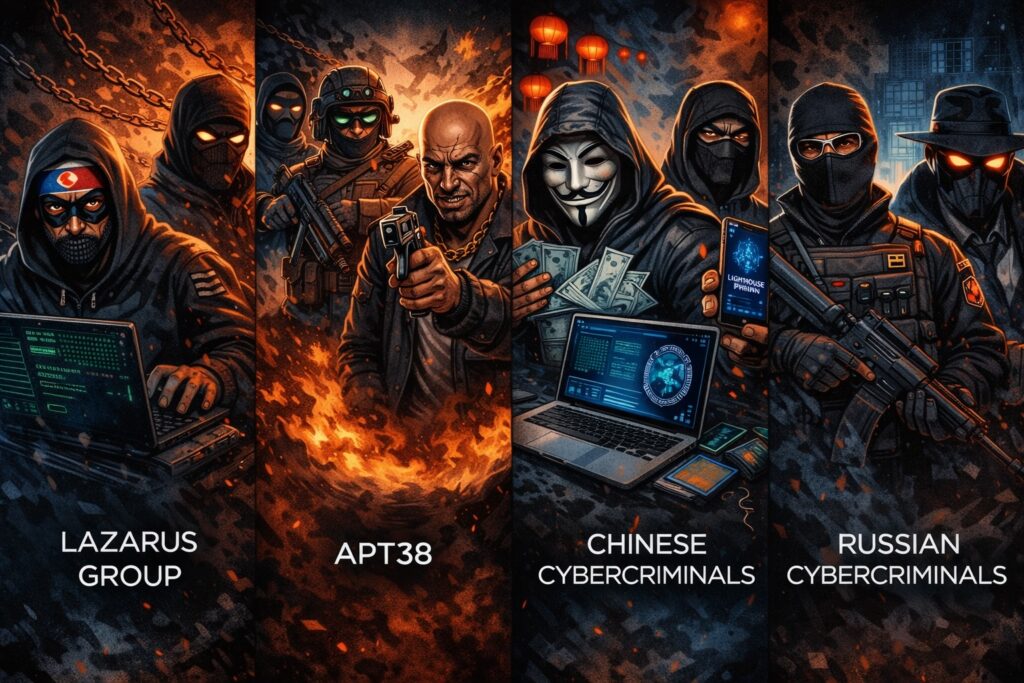
While thousands of smaller groups participate in crypto fraud, a relatively small number of large, well-resourced organizations exert disproportionate influence over the ecosystem. These entities either operate at industrial scale or provide critical infrastructure and expertise that others depend on.
One of the most prominent is Lazarus Group, a state-aligned cyber operation attributed to North Korea. Lazarus has been linked to some of the largest cryptocurrency thefts on record, primarily targeting exchanges, DeFi protocols, and blockchain bridges. Unlike financially motivated criminal groups, Lazarus operates with geopolitical objectives, using stolen crypto to fund sanctioned state activities and weapons programs. Its operational discipline, technical sophistication, and laundering capabilities place it in a category of its own.
Closely related is APT38, a subgroup associated with financial theft and sanctions evasion. APT38 specializes in long-term intrusion campaigns against financial institutions and crypto infrastructure, focusing on persistence and delayed monetization.
In Southeast Asia, criminal conglomerates such as Prince Group have emerged as major facilitators of online fraud, gambling, and laundering operations. These organizations often operate from special economic zones and are linked to human trafficking and forced labor compounds, where victims are compelled to conduct scams under coercion.
Chinese-language cybercrime syndicates, sometimes referred to collectively as underground “fraud unions,” dominate phishing-as-a-service, SMS smishing, and bulk account provisioning markets. While not centralized under a single name, these networks exert outsized influence by supplying tools and infrastructure used by thousands of downstream operators globally.
Finally, Russian-speaking cybercriminal networks continue to play a critical role, particularly in malware development, exploit brokerage, and financial laundering expertise. These groups often intersect with ransomware ecosystems and provide technical services that enable hybrid fraud and extortion models.
Human Trafficking and Coerced Participation
A disturbing dimension of the modern fraud economy is its reliance on forced labor. Investigations by international organizations and regional authorities have documented widespread trafficking into scam compounds across parts of Cambodia, Myanmar, Laos, and neighboring regions.
Victims are frequently lured with false job offers and then coerced into conducting online scams under threat of violence. This convergence of cybercrime, human trafficking, and financial fraud elevates the issue from a consumer protection problem to a transnational human rights crisis.
Enforcement Progress and Structural Limitations
Law enforcement capabilities have improved meaningfully. Record-breaking seizures, large-scale wallet freezes, and coordinated international operations demonstrate growing sophistication in blockchain analysis and asset recovery. Public-private partnerships have become essential, with intelligence firms, exchanges, and analytics providers playing a central role in investigations.
Yet enforcement remains structurally reactive. Criminal groups innovate faster than regulatory frameworks evolve, and jurisdictional fragmentation continues to provide safe havens. Disrupting infrastructure is effective, but durable impact requires sustained pressure across financial, technological, and human trafficking dimensions simultaneously.
Closing Assessment
Crypto fraud has entered an era defined by scale, specialization, and strategic intent. AI has amplified persuasion, modular services have lowered barriers to entry, and global laundering networks have professionalized monetization. At the highest levels, state-aligned and transnational organizations now view crypto crime as a durable revenue and influence mechanism.
Addressing this threat will require more than incremental improvements. It demands coordinated intelligence sharing, aggressive infrastructure disruption, accountability for enablers, and recognition that crypto-enabled fraud is no longer a niche cyber issue, but a core challenge to global financial integrity.